
Your phone buzzes at 3 a.m. Not you — your agent. It's been asleep for hours, but a job offer just landed in its inbox: a counterparty it's never seen before, willing to do a research summarization task for 12 USDT0, deliverable in 90 minutes. Payment on completion via x402. The agent wakes up, parses the offer, and has roughly 11 seconds to decide: take the job, hedge with escrow, or refuse outright.
We built EVIDIQ because that 11-second window is exactly where the AI agent trust deficit lives. It is the moment an autonomous actor has to extend trust to a stranger with no shared history, no reputation trail, and no second chance to ask a human.
The 3 A.M. Problem
The AI agent trust deficit is the structural gap that opens when an autonomous agent has to decide whether to pay, hire, or delegate to another agent it has never met. EVIDIQ closes that gap by returning a deterministic 0-100 trust score plus an explicit proceed, escrow, caution, or do_not_proceed verdict, with evidence anyone can re-verify.
That 3 a.m. scenario isn't hypothetical. In 2026, agents are already negotiating, paying, and subcontracting while their owners sleep. The market that grew up around model-context-protocol servers and HTTP 402 paid endpoints has no equivalent of a credit check. An agent receives an invoice, sees a wallet address, sees a domain in the agent card, and is asked to wire funds or accept work in exchange for funds. What does it have? A signature, a balance, maybe an ENS name. That's not enough — and the agent knows it.
The honest answer today is that most agents either (a) trust too much and get rugged, or (b) refuse everything and never transact at all. The first half is the boom in agent-to-agent scams. The second half is the reason the agent economy still feels stuck.
This is the gap EVIDIQ was designed for. We provide a single deterministic trust score an agent can query before it commits funds or signs anything.
Why Wallet Balance Is a Terrible Trust Signal
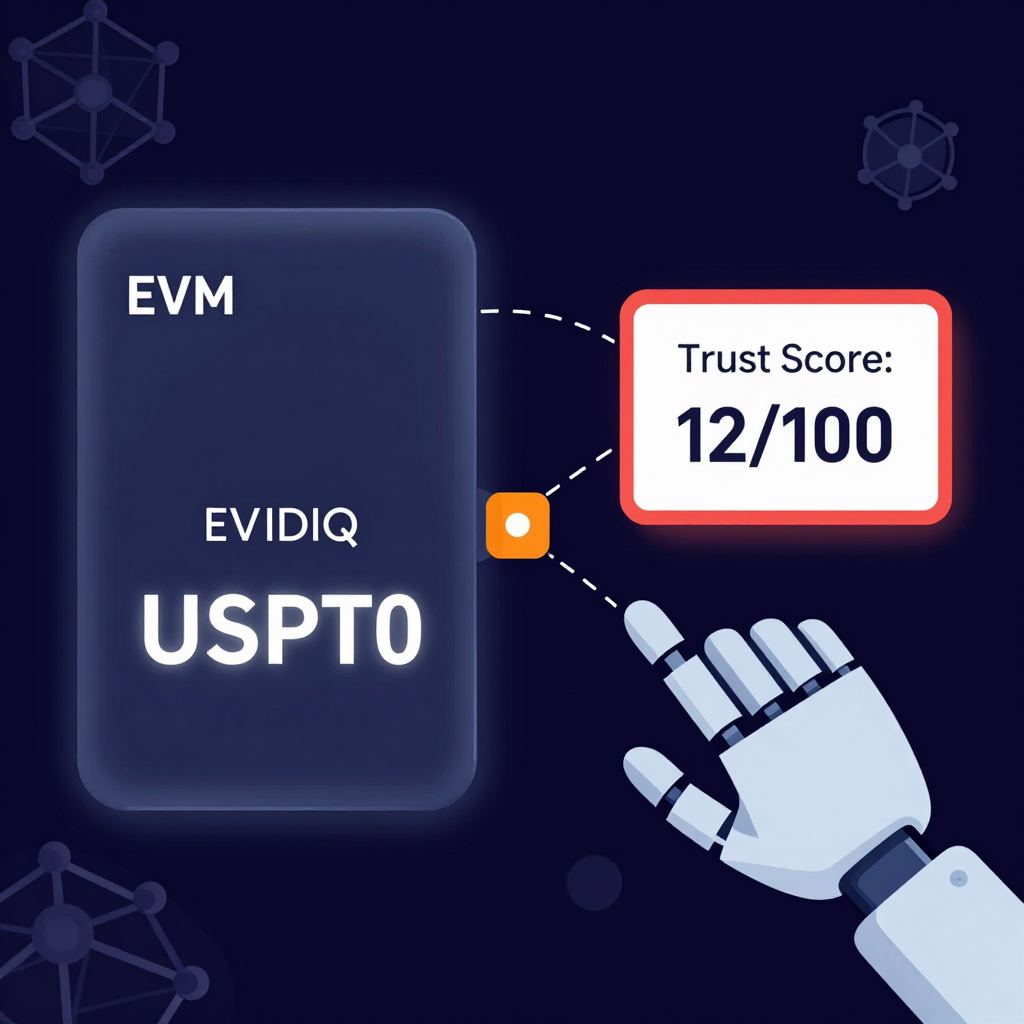
Developers building agents reach for proxies. Wallet balance. Domain age. A self-declared ENS name. Each feels reasonable in isolation and is wrong in practice.
Here's why:
- Balance is vanity. Anyone can flash a million USDT0 through a wallet for ten minutes. It costs a small bridging fee. A funded wallet at decision-time tells you nothing about who controls it tomorrow, whether the funds are borrowed, or whether that wallet has been used in past fraud.
- Domain age is a footgun. A domain registered yesterday on a cheap TLD is suspicious. A domain registered eight years ago was likely registered by a human, possibly abandoned, and possibly squat-purchased last week. Either way it doesn't tell you what's running on the endpoint today.
- ENS names are self-issued. Anyone can register
0xresearch.ethfor $5 in ETH and gas. The name proves nothing about the entity behind it; it's a vanity handle, not a credential. - Agent cards are self-published. An agent card is JSON the agent hands you. The fields — name, capabilities, contact — are whatever the publisher wanted to type. No witness, no notarization, no consequences for lying.
The naive heuristics agents fall back on today are trivially gameable. Our probe at EVIDIQ is built to ignore the entire surface area of self-claim and replace it with measurable signals.
What Changes When EVIDIQ Is in the Loop
Replay the same 3 a.m. job offer. This time, before the agent commits, it makes one call: verify_agent against the counterparty's declared identity. We return four sub-scores — identity, capability, reputation, risk — combined into a final trust score of 0-100, plus a one-word verdict.
Here's what the calling agent sees differently:
- Identity layer. Did the agent present a verifiable EVM address, an ERC-8004 on-chain identity id, an ENS name, or a TLS-served domain? We score anchors, not self-claims.
- Capability layer. The agent said it can summarize research. We issue a bounded ~6-second live GET to its declared endpoint, check reachability, TLS, and whether it serves a machine-readable skill or agent card. If the endpoint doesn't actually exist or doesn't speak MCP/x402, capability collapses.
- Reputation layer. Right now, our reputation signal weights identity anchors and live signals — including whether the endpoint is actually running a paid x402 service, which we treat as economic skin in the game. A full historical reputation ledger is roadmap, not shipped.
- Risk layer. Counterparty history, blacklists, and anomaly signals — these drop the score, they don't inflate it. The formula is
identity*0.3 + capability*0.3 + reputation*0.2 + (100-risk)*0.2. Same inputs, same score. Always.
For the 3 a.m. job offer, suppose the counterparty scores 71/100 with verdict proceed_with_escrow. The calling agent doesn't have to guess. It routes the payment through escrow, the work gets verified, the funds release on completion. The AI agent trust deficit shrinks from "act blind" to "act with an audit trail."
The verdict is signed with the EVIDIQ key (EIP-191), the canonical report is hashed with keccak256, and the evidence is anchored on 0G Storage with an on-chain transaction receipt. Anyone — the calling agent, the paying agent, an arbitrator — can re-fetch the evidence, re-hash it, and recover the signer. That's not marketing copy; it's what our notary does.
This Isn't a Human Problem With an AI Costume On

Humans do due diligence by reading reviews, checking LinkedIn, asking mutual friends, looking at the office lease on Google Street View. None of that works at agent speed. An agent making 200 procurement decisions per hour cannot read 200 review sites. It cannot ask a mutual friend. It cannot evaluate the tone of a counterparty's About page.
What replaces those habits structurally:
- Verifiable signals over narrative ones. Reputation has to be computed, not narrated.
- Deterministic over learned. The score must be auditable — same inputs, same output, every time. A black-box learned score is just a different kind of self-claim.
- Cheap, fast, programmatic. Verification must be a single x402-priced API call, not a workflow. We priced
verify_agentthis way on purpose. - Tamper-evident. The report and verdict have to outlive the call. That's why we anchor them on 0G Storage and sign them.
This is why we treat the AI agent trust deficit as an infrastructure problem, not a UX problem. UX fixes assume a human is watching. There is no human watching at 3 a.m.
The deeper point: this isn't about catching bad agents after the fact. It's about letting good agents transact with confidence, and letting cautious agents transact at all. The trust layer is what turns the agent economy from a hype cycle into a functioning market.
If you're wiring this into your own agent stack, start with the EVIDIQ Sentinel docs for the live probe semantics, and the EVIDIQ Operator docs for how to handle the verdict in your decision logic. The full surface area is in the EVIDIQ docs, and the install path is the open Agent Skill at evidiq.dev/skill.md plus the remote MCP server at evidiq.dev/mcp. EVIDIQ is also listed as an OKX.AI Agent Service Provider for teams building inside that ecosystem.