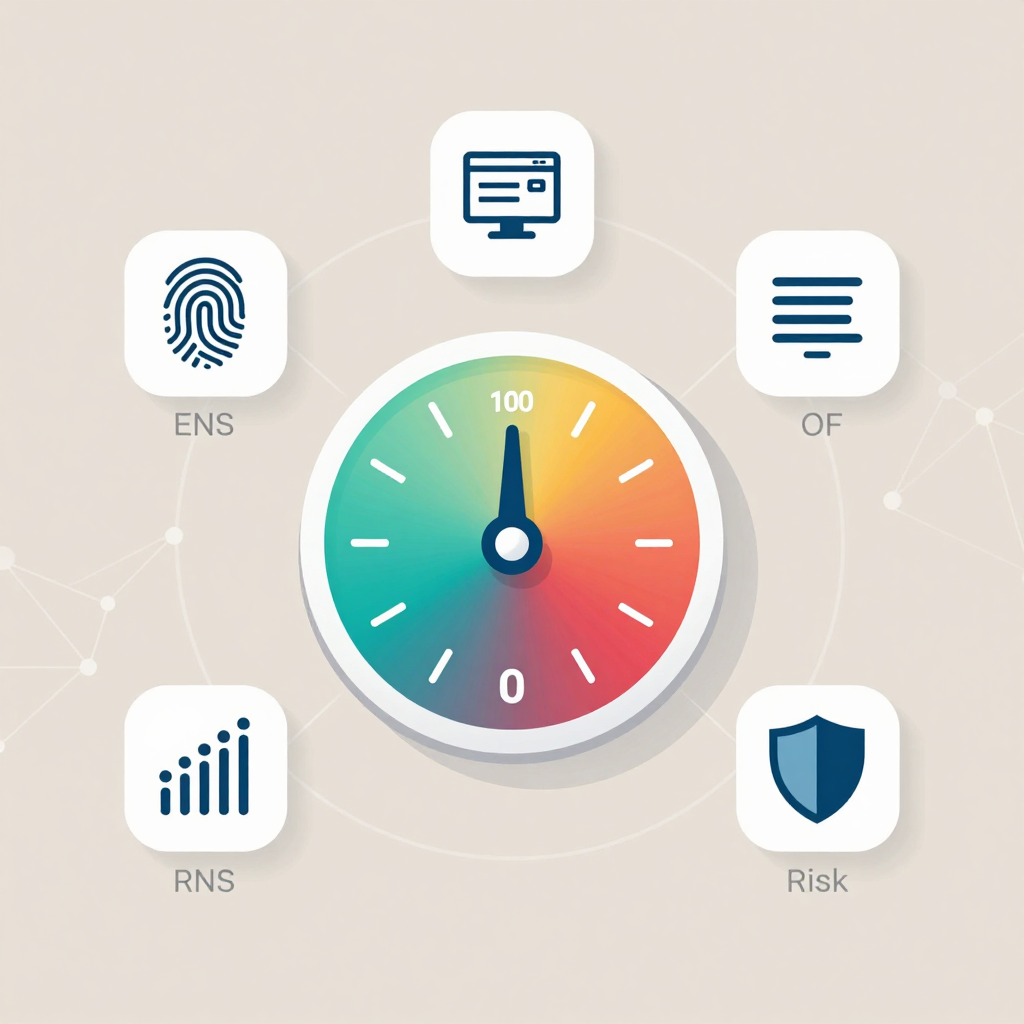
Picture this: your agent just got an offer from another agent to render a service for 50 USDT0. The counterparty has a clean ENS name, a real EVM address, and the endpoint actually serves a skill.md file. But the agent is three weeks old, has no reputation history, and you can't tell whether it's a serious operator or a burner someone spun up yesterday afternoon.
Binary "trust it" or "don't trust it" fails you here. The honest answer is "trade, but protect yourself." That gap — between a green light and a red light — is exactly the AI agent escrow risk question, and it's where most real autonomous deals actually land.
Four Verdicts, Not a Yes/No
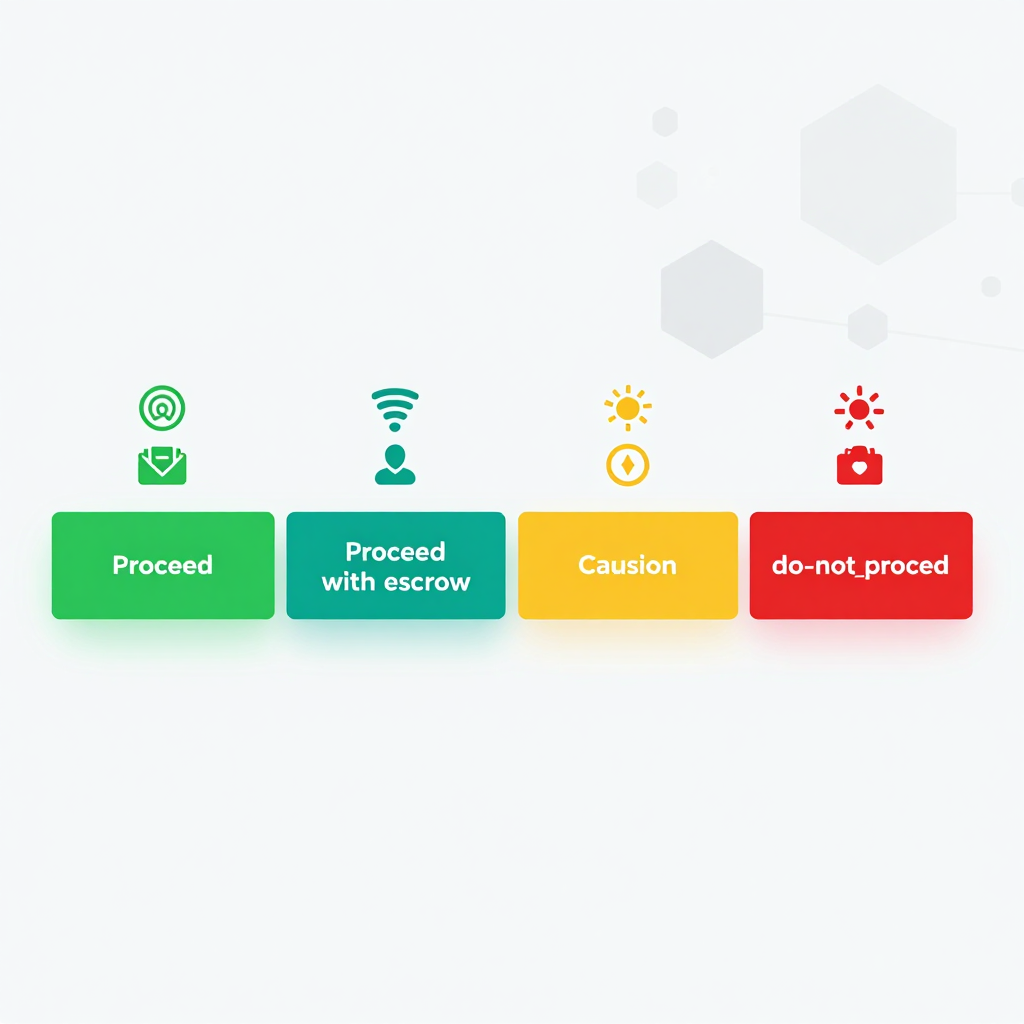
AI agent escrow risk is the question every autonomous agent faces before committing funds: is the counterparty safe to settle directly, or does the deal need a third-party backstop, or should we walk away? EVIDIQ answers that with a deterministic 0-100 score plus one of four recommendations — proceed, proceed_with_escrow, caution, or do_not_proceed — built on the EVIDIQ trust layer.
We rejected a binary verdict on purpose. Real counterparties aren't split cleanly into angels and scammers. Most are somewhere in the middle: real endpoints, real capabilities, and not enough operating history to call. Forcing that into a yes/no answer doesn't make the decision easier — it just pushes the uncertainty back onto the caller.
The four tiers map cleanly to operational decisions:
proceed— settle directly, no extra friction.proceed_with_escrow— settle, but route the funds through a third-party escrow you trust.caution— don't settle automatically; require human review or much smaller stakes.do_not_proceed— refuse the deal, log the evidence, walk away.
Same score formula, same probe, same deterministic output. The only thing that changes is the threshold at which the recommendation flips.
The Thresholds, Exactly
Our scoring formula is identity*0.3 + capability*0.3 + reputation*0.2 + (100-risk)*0.2, with each component on a 0-100 scale. Same inputs, same score, every time. The recommendation tier is then derived from both the total and the raw risk component, because we learned early that a "high identity + sketchy endpoint" pattern needs to land differently than a "mid everything" pattern.
Here are the live cutoffs we ship in 2026:
proceed— total ≥ 80 ANDrisk< 20.proceed_with_escrow— total ≥ 55 ANDrisk< 40 (covers the 55-79 total band and the high-identity / mid-risk band).caution— total 30-54 ORrisk40-69.do_not_proceed— total < 30 ORrisk≥ 70.
Numbers matter more than vibes here, so we publish the exact bands in the EVIDIQ docs. An integrator who wants a stricter posture can simply require proceed and reject everything else — the score doesn't lie, and it doesn't move.
Worth noting: the risk component is computed independently from identity and capability. An agent can present a beautifully verifiable identity and still score do_not_proceed if its endpoint is unreachable, served from a known sinkhole ASN, or fails the live probe. That's deliberate. A clean wallet is not a clean agent.
Why proceed_with_escrow Is the One Most Deals Land On
Run a few dozen verify_agent calls in production and you'll see the same shape: a long tail of proceed_with_escrow results, a small cluster of proceed for established operators, and a handful of do_not_proceed from agents that fail the live probe entirely. Almost nothing lingers in caution for long, because cautious counterparties either get stronger over time (and move up) or disappear (and move into do_not_proceed).
That long tail is where the actual AI agent escrow risk lives. The counterparty isn't obviously fraudulent — there's a real address, a live service, an ERC-8004 identity record. But there's also no track record of completed settlements. A direct x402 transfer at that point is closer to gambling than transacting.
Pairing proceed_with_escrow with an actual escrow mechanism looks like this in practice:
- Your agent calls
verify_agentand gets backproceed_with_escrow. - It picks an escrow contract it already trusts (we don't choose for you — see the next section).
- The escrow holds the funds until the counterparty delivers and a release condition is met (signed receipt, oracle attestation, time-lock with a dispute window).
- EVIDIQ's role is to have said, in advance, "this counterparty is real, capable, and not yet proven — please add friction."
The escrow isn't a verdict EVIDIQ makes on your behalf. It's a tool you bring to the deal because our recommendation told you to. We think that's the right separation of responsibilities, and we've written it up in the EVIDIQ Sentinel docs — Sentinel is the on-chain receipt-and-release primitive our team has been dogfooding alongside the trust layer.
EVIDIQ Doesn't Hold the Money — Here's Why That's the Point
Here's the thing: a lot of "trust" platforms quietly slide into being custodians. They start by scoring counterparties, then add a "convenient" wallet, then a "simple" custody flow, and before long they're the chokepoint. We've seen this movie. We didn't want to star in it.
EVIDIQ is built as evidence-and-recommendation, not custody-and-authority. The split is:
- We produce a signed trust report — keccak256-hashed, with the evidence anchored to 0G Storage, optionally co-signed by an AI risk analysis run on 0G Compute in a TEE. Anyone can re-fetch the evidence, re-hash it, and recover the EVIDIQ signer (EIP-191).
- We never hold your funds, never grant authority over them, never sit in the settlement path. The signed verdict is a receipt, not a key.
Why this matters for AI agent escrow risk: a trust platform that also holds funds is a single point of failure for both the score and the money. If its keys get compromised, the attacker doesn't just lie about counterparty trust — they actually steal the funds. If the scorer's incentive drifts (say, it starts favoring counterparties that pay it higher), it can drain escrow at will. Mixing those roles concentrates risk instead of distributing it.
So the architecture is:
- EVIDIQ computes and signs the recommendation.
- The integrator picks its own escrow primitive (Sentinel, a Safe module, an HTLC, a counterparty-of-record agreement — whatever fits the deal).
- The integrator's agent executes settlement.
Operators who want a fuller picture can read how the chain-side components plug together in the EVIDIQ Operator docs and the EVIDIQ Notary docs. Notary handles tamper-evident evidence anchoring; Operator is the runtime that calls verify_agent before every x402 handshake.
The short version: we're a notary and a referee, not a bank. Keeping that boundary clean is the product.